
If you’ve been noticing white crusty buildup on your faucets or dry skin after a shower, you’re likely dealing with hard water—a common issue where high mineral content (like calcium and magnesium) wreaks havoc on your home.
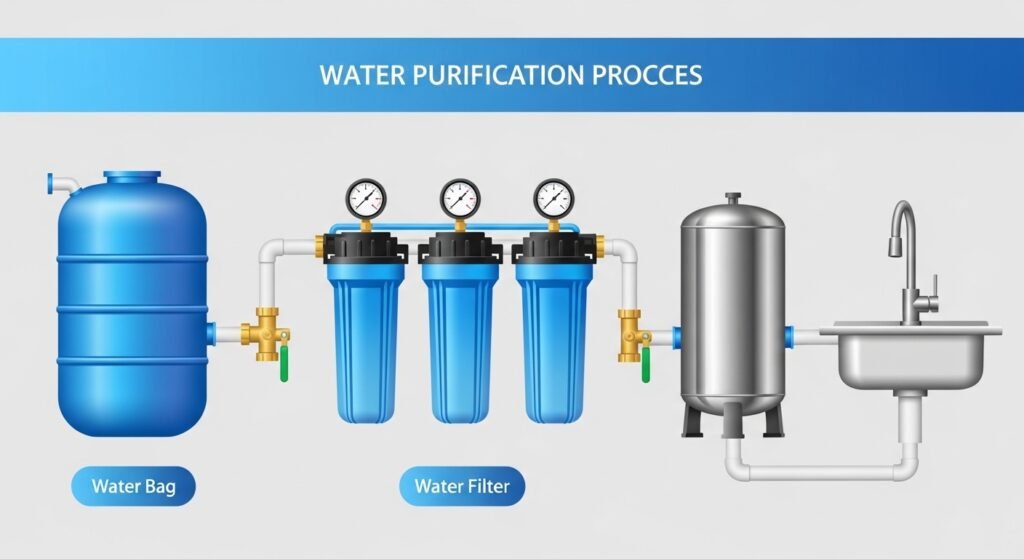
Here is a detailed breakdown of the water purification process and how a clear filtration system protects your household.
1. The Storage Phase: The “Water Bag”
The process begins at the source or storage tank, labeled here as the “Water Bag.” In many residential setups, this represents the point where raw water enters the system—whether from a municipal line or a well. At this stage, the water contains all the minerals, sediment, and potential contaminants it picked up along its journey.
2. The Multi-Stage Filtration Journey
The heart of the system is the Water Filter section, typically consisting of three distinct canisters. This multi-stage approach is vital because one filter alone can’t catch everything.
- Stage 1: Sediment Filtration The first canister usually acts as a “bouncer.” It catches larger particles like sand, rust, and silt. This protects the subsequent, more delicate filters from getting clogged too quickly.
- Stage 2: Carbon Block/Activated Carbon The middle canister focuses on chemistry. Carbon filters are excellent at removing chlorine, bad odors, and volatile organic compounds (VOCs). This is where the “taste” of your water significantly improves.
- Stage 3: Fine Micron/Specialty Filtration The final canister provides a polished finish, catching microscopic contaminants or specific minerals that cause scaling.
3. The Final Conditioning
After the three canisters, the water passes through a final vertical cylinder. In high-end systems, this is often a post-filter or a UV sterilizer. This stage ensures that any remaining bacteria are neutralized and the water is perfectly “clear”—meaning it won’t leave those devastating hard water spots on your glass shower doors or inside your dishwasher.
4. Delivery: Purified Water
Finally, the water reaches the sink. Because it has been stripped of the abrasive minerals that cause “hard” water, you’ll notice:
- No more scale buildup on the aerator of your faucet.
- Longer-lasting appliances (water heaters and dishwashers don’t have to fight mineral “sludge”).
- Better soap lather, leading to cleaner dishes and softer hair.
Why the Transition to Clear Filtration Matters
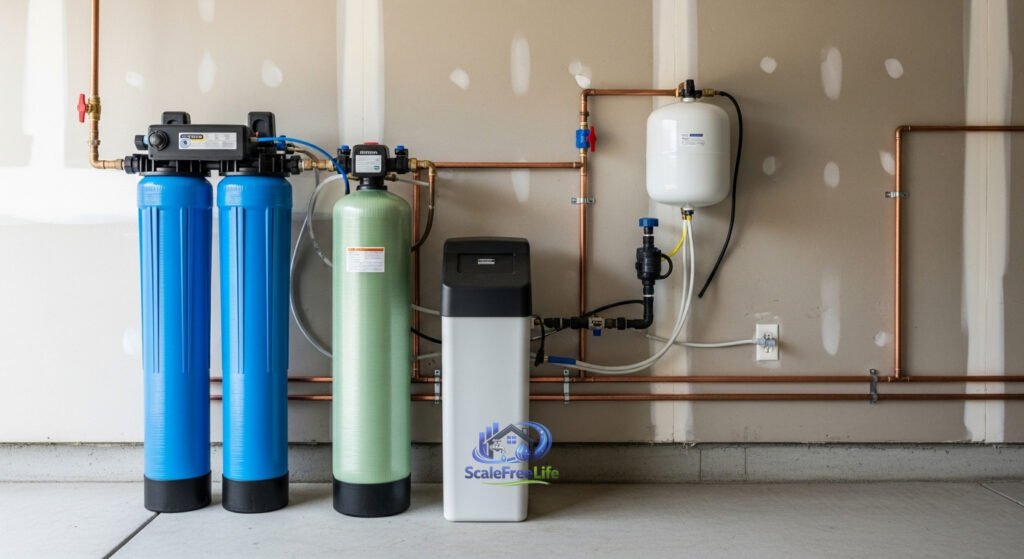
Traditional salt-based softeners often just swap calcium for sodium. A modern clear filtration system focuses on actually removing the problem. By identifying the signs of hard water early—like that stubborn white film on your fixtures—you can transition to a system like the one pictured, saving your plumbing and your skin in the long run.