
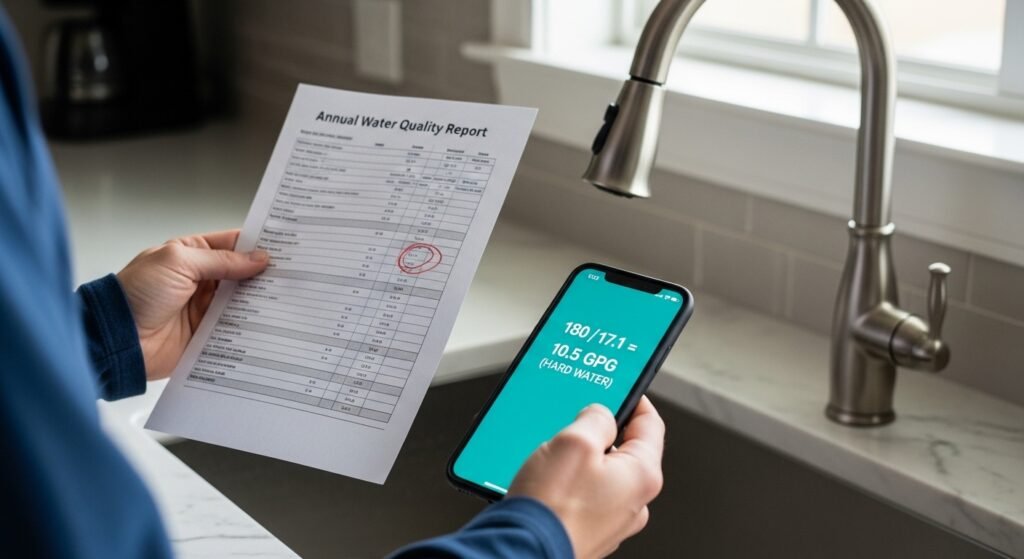
Ever get that thick envelope from your city titled “Annual Water Quality Report” or “Consumer Confidence Report (CCR)”? If you’re like most people, it probably goes straight into the recycling bin, or worse, gathers dust in a drawer.
But what if I told you those 20 pages hold the secret “DNA” of your home’s health, directly impacting your appliances, your skin, and even your family’s well-being?
It’s time to stop ignoring it. Let’s decode it.
The Problem: Jargon Overload
Your city water utility does an incredible job of delivering safe, potable water to your tap. But when it comes to explaining it, they often speak a language only chemists understand. Terms like “MCL,” “PPM,” “Turbidity,” and “Grains Per Gallon” can make the report feel impenetrable.
But fear not! You don’t need a science degree to understand the most critical information. We’re going to focus on the three red flags that tell you if your water is just “safe” or truly “clean” and gentle for your home.
Red Flag #1: The Contaminant Table & the MCL
This is often the longest section of your report, a sprawling table with columns for different contaminants, their detected levels, and something called MCL.
What is MCL? MCL stands for Maximum Contaminant Level. Think of it as the federal speed limit for specific substances in your drinking water. If your city’s “Detected Level” is above the MCL, that’s a serious problem, and your city is legally obligated to notify you immediately.
What to look for: Scan this table for any contaminant where the “Detected Level” is getting uncomfortably close to the “MCL.” While it might be “legally safe,” it suggests your water supply is consistently pushing the boundaries. Pay particular attention to common issues like Lead, Nitrates, and Chlorine byproducts.
Example: Imagine your report shows Lead at 10 ppb (parts per billion) and the MCL is 15 ppb. It’s technically “safe,” but it’s a signal that your old pipes might be a concern, and you might want to consider further filtration.
Red Flag #2: Decoding “Hardness” (PPM to Grains Per Gallon)
This is perhaps the most overlooked, yet impactful, section for your home and appliances. Hard water isn’t a health risk, but it’s an absolute nightmare for your plumbing.
Your report will likely list “Hardness” in PPM (Parts Per Million) or mg/L (milligrams per liter)—which are essentially the same. But for most homeowners, Grains Per Gallon (GPG) is a more intuitive measure.
The Magic Formula: To convert PPM to Grains Per Gallon, use this simple calculation: PPM / 17.1 = Grains Per Gallon (GPG)
What do the numbers mean?
- 0-3.5 GPG: Soft Water (Lucky you!)
- 3.5-7 GPG: Moderately Hard Water
- 7-10.5 GPG: Hard Water
- 10.5+ GPG: Very Hard Water (Welcome to the club, Dallas homeowners!)
Why it matters: Hard water means your water is loaded with dissolved minerals like calcium and magnesium. These minerals are the culprits behind:
- Crusty buildup on faucets and showerheads
- Spots on dishes and glassware
- Dry, itchy skin and dull hair after showering
- Reduced efficiency and lifespan of water heaters, dishwashers, and washing machines (costing you money!)


Red Flag #3: Turbidity and Chlorine (The “Taste and Smell” Factors)
While the report focus is often on safety, your daily experience with water comes down to Turbidity and Residual Chlorine.
- Turbidity: This is a measure of the “cloudiness” of the water. While the city filters most of it out, high turbidity can act as a shield for viruses and bacteria, making disinfection less effective. If you see high levels here, it’s a sign that your water might need a final “polishing” before it hits your glass.
- Chlorine/Chloramines: Cities use these to keep water safe from the plant to your house. However, once the water reaches your tap, the chlorine has done its job. Leaving it in can lead to that “swimming pool” smell and taste, and it can be harsh on your skin and hair.
From “Legally Safe” to “Home Pure”
The city’s job is to meet the MCL. Your job is to decide what level of quality you want for your family and your biggest investment—your home.
Once you’ve decoded your report, you can stop guessing. If your report shows high hardness (over 7 GPG) or chlorine levels that bother you, the solution isn’t just “softening” the water with salts. The modern transition is toward clear filtration systems that remove the contaminants and the minerals that cause scale, leaving you with water that is as pure as it is safe.
Action Step: Find Your Report Today
Don’t wait for the next paper copy to arrive. Most cities have their latest Consumer Confidence Report available online right now.
- Search for “[Your City] Annual Water Quality Report.”
- Find the Hardness and MCL columns.
- Do the math (PPM / 17.1).
Knowing the DNA of your water is the first step to protecting your home.